 Prime-time disappointment
 Trump touts gains against Iran but gives no timeline to end war
 India central bank's fresh FX curbs trap banks in trades once seen low risk
 Takeaways from Trump's speech on Iran
 The Artemis II astronauts — fresh off historic mission — take questions about their moon journey
 Ex-NBA player Damon Jones is expected to become first person to plead guilty in gambling sweep
 Man plans to plead guilty in killing of Run-DMC's Jam Master Jay. 2 other men went to trial
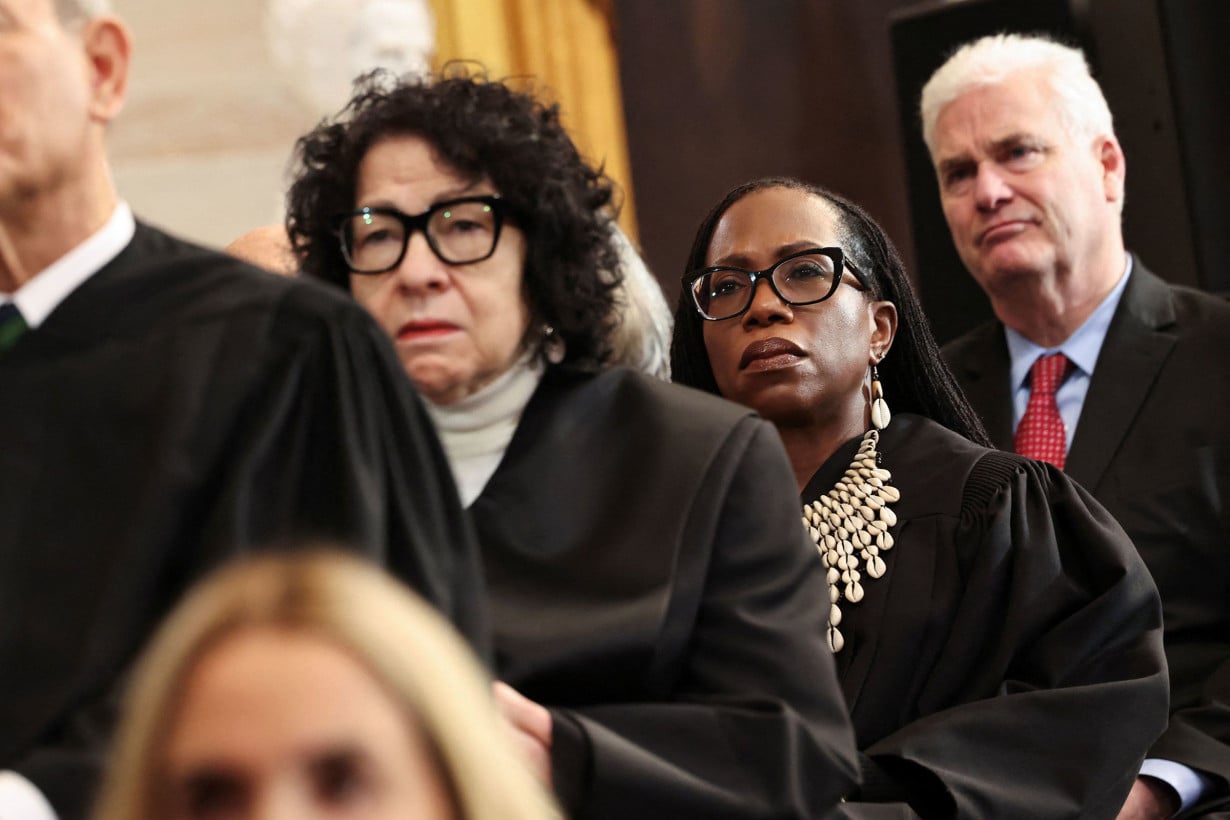
(CNN) — The Supreme Court’s emergency docket has resurfaced as a flashpoint within the federal judiciary as justices openly snipe at one another over the handling of short-fuse appeals, especially those involving President Donald Trump’s policies.
The renewed debate over what critics call the “shadow docket” has been at the center of several recent instances of tension between the justices spilling out into public view – including an unusually harsh broadside Justice Sonia Sotomayor leveled at a conservative colleague.
Sotomayor, the court’s senior liberal, issued a rare public apology on Wednesday for suggesting earlier that Justice Brett Kavanaugh’s privileged upbringing influenced his approach to an emergency immigration case last year. A day before her mea culpa, a newly posted video revealed that Justice Ketanji Brown Jackson had spent more than an hour lambasting the court’s conservative majority for its handling of quick turn cases.
“Back then, the justices humbly waited,” Jackson, the court’s junior liberal, told Yale Law School as she drew a comparison between the modern court and how she said the justices dealt with emergency matters when she was a clerk two decades ago. “Things are different now.”
The court, Jackson said, has failed to grasp how its “scratch paper musings” caused “real-world harms.”
It can take months, and even years, to decide if a president’s policy is legal. On the shadow docket, the court decides if that policy remains in effect, or not, while that process plays out. Because of the speed at which the court must move, it rarely holds oral arguments or receives the same level of briefing to make that decision.
Lower courts have wrestled for months with whether the Supreme Court’s emergency orders – sometimes referred to as “interim orders” – carry the weight of precedent beyond the case at hand. That can prove especially tricky when the Supreme Court offers little explanation of its reasoning, or the facts of a subsequent case are slightly different.
The revived criticism of the process has landed as the Supreme Court is heading into its most intense period, with justices working behind the scenes to draft opinions in the most significant merits cases ahead of summer recess. In coming weeks, the court will decide major merits appeals on Trump’s power to fire federal officials, his effort to end birthright citizenship for millions of people and Republican efforts to alter this year’s midterm election.
At the same time, the emergency docket itself has lightened considerably this year as challenges to many of Trump’s most controversial early domestic policies have either run their course or already reached the high court.
Last year, the Supreme Court docketed roughly 30 emergency cases involving Trump policies. The justices allowed the president to remove the leaders of some independent agencies while courts considered the legality of their firings. They also let Trump unilaterally cut funding approved by Congress, halt temporary deportation protections for many immigrants and bar transgender service members from the military.
On the other hand, the court blocked Trump from removing Federal Reserve Governor Lisa Cook and it rejected his effort to deploy the National Guard to protect ICE agents.
The court’s defenders note that, unlike in merits cases, the Supreme Court has to rule one way or the other when an emergency case lands on its doorstep. And the justices don’t control which emergency cases an administration chooses to file.
Downstream effects
Criticism of the docket crops up every few years. But it is increasingly members of the judiciary themselves who are raising concerns. In recent weeks, several lower courts have openly debated what to do with the court’s often terse emergency orders.
“Interim orders are frequently issued without full briefing and without oral argument. That counsels caution, not expansion,” US Circuit Judge James Wynn, an Obama appointee, wrote in a decision this month allowing the Trump administration’s Department of Government Efficiency to access Social Security Administration data. The Supreme Court had sided with DOGE in that case in an emergency order last year.
“To treat interim orders as binding precedent abandons our long-held jurisprudence of deciding constitutional law through reasoned opinions, not emergency motions made under intense time pressure,” Wynn wrote. “More profoundly, it would weaken the public’s confidence in the integrity of our judicial system’s commitment to deliberation and transparency.”
US Circuit Judge Julius “Jay” Richardson, a Trump nominee, saw it differently.
“This court is an inferior one,” he wrote in the same case. “When the Supreme Court speaks, inferior courts must listen.”
Trump’s Justice Department has been aggressively pushing the idea in lower courts that previous emergency decisions from the Supreme Court should decide the outcome of subsequent cases. That is what has happened in a series of cases involving what’s known as Temporary Protected Status, a form of humanitarian relief for certain immigrants. The court in October allowed the administration to strip TPS for some 300,000 Venezuelans living in the United States.
When the administration’s effort to remove TPS for Ethiopian nationals was challenged in federal court, the administration cited the Supreme Court’s order in the Venezuelan case. US District Judge Brian Murphy rejected that argument in a ruling his month. The Biden nominee noted that the Supreme Court had deferred a decision in two other emergency cases dealing with the same protections for Haitians and Syrians.
“Note that the Supreme Court gave no explanation for its recent stays of related, but not identical, district court orders,” Murphy wrote in a footnote.
The Trump administration appealed the decision the next day.
‘Hurtful comments’
Sotomayor’s apology followed remarks she made to an audience in Kansas last week in which she criticized Kavanaugh for his concurring opinion in an emergency immigration case dealing with ICE patrols. That decision backed Trump’s push to allow immigration enforcement officials to continue what critics describe as “roving patrols” in California that lower courts said likely violated the Fourth Amendment.
The court offered no explanation for its ruling. Perhaps responding to criticism about how frequently the majority doesn’t explain its position in emergency orders, Kavanaugh picked up his pen to explain his vote.
Kavanaugh said that the factors the agents were using to stop migrants “taken together can constitute at least reasonable suspicion of illegal presence in the United States.” Those factors could include a person’s apparent ethnicity, for instance, language or their presence at a particular location, such as a farm or a bus stop.
“Importantly,” Kavanaugh added, “reasonable suspicion means only that immigration officers may briefly stop the individual and inquire about immigration status.”
Immigrant advocacy groups have said the stops are often lengthier and more intrusive than Kavanaugh made them seem in his opinion. Sotomayor, who dissented in the case, picked up on that line of criticism as she spoke at University of Kansas School of Law.
“I had a colleague in that case who wrote, you know, these are only temporary stops,” Sotomayor said, according to a Bloomberg report. “This is from a man whose parents were professionals. And probably doesn’t really know any person who works by the hour.”
Scrutiny of her remarks ballooned because they departed from the image of collegiality the justices almost always portray in their public remarks. On Wednesday, Sotomayor acknowledged that her comments were “hurtful” and “inappropriate.”
Sotomayor did not, however, walk back her thoughts about the emergency docket. Speaking in Alabama days after her visit to Kansas, Sotomayor said the Supreme Court itself was to blame for last year’s flood of emergency cases.
“We’ve done it to ourselves,” she said.
Jackson v. Kavanaugh
An otherwise breezy conversation between Jackson and Kavanaugh last month turned tense when the moderator asked about the court’s emergency docket. Kavanaugh said he believes the rise in emergency cases is at least partly attributable to presidents eager to push policies past a gridlocked Congress via executive actions.
The Trump nominee said that some of the criticism of the court’s emergency docket is unfair, given that the court must rule one way or the other on whether to grant or deny those cases.
And he questioned the “short memories” of some of the court’s critics, noting that the Biden administration also regularly appealed cases when lower courts shut down its policies.
In a preview of her address at Yale, Jackson said then that she believes the court itself is at least partly to blame.
“I think it’s because the Supreme Court has shown a willingness to grant these emergency motions,” she said. “Brett will remember that when we clerked some 20 years ago, this was not the Supreme Court’s stance, that just because these motions were filed the court actually had to entertain and grant them on their merits.”
Kavanaugh suggested that some of the criticism of the emergency docket seemed to be based on how people feel about the underlying case.
“Ketanji states it well,” he said, before adding that “you have to have the same position, no matter who’s president.”
“I agree with that,” Jackson said.
“I know you do,” Kavanaugh added.
The-CNN-Wire
™ & © 2026 Cable News Network, Inc., a Warner Bros. Discovery Company. All rights reserved.