 Maryland exercises its right to match an $85 million offer to keep Preakness branding rights
 South Dakota man whose life sentence was commuted by Noem now implicated in his niece's death
 US extends flight limits at New York area airports
 ICC sets July 24 vote on whether to remove chief prosecutor Karim Khan, WSJ reports
(CNN) — As key Republicans on Capitol Hill first learned the details of President Donald Trump’s agreement with Iran, some were so stunned that they simply wouldn’t speak about it.
But within 24 hours, a significant bloc of GOP senators has begun openly doubting the terms of Trump’s Iran negotiations — with many urging him to pivot his strategy entirely.
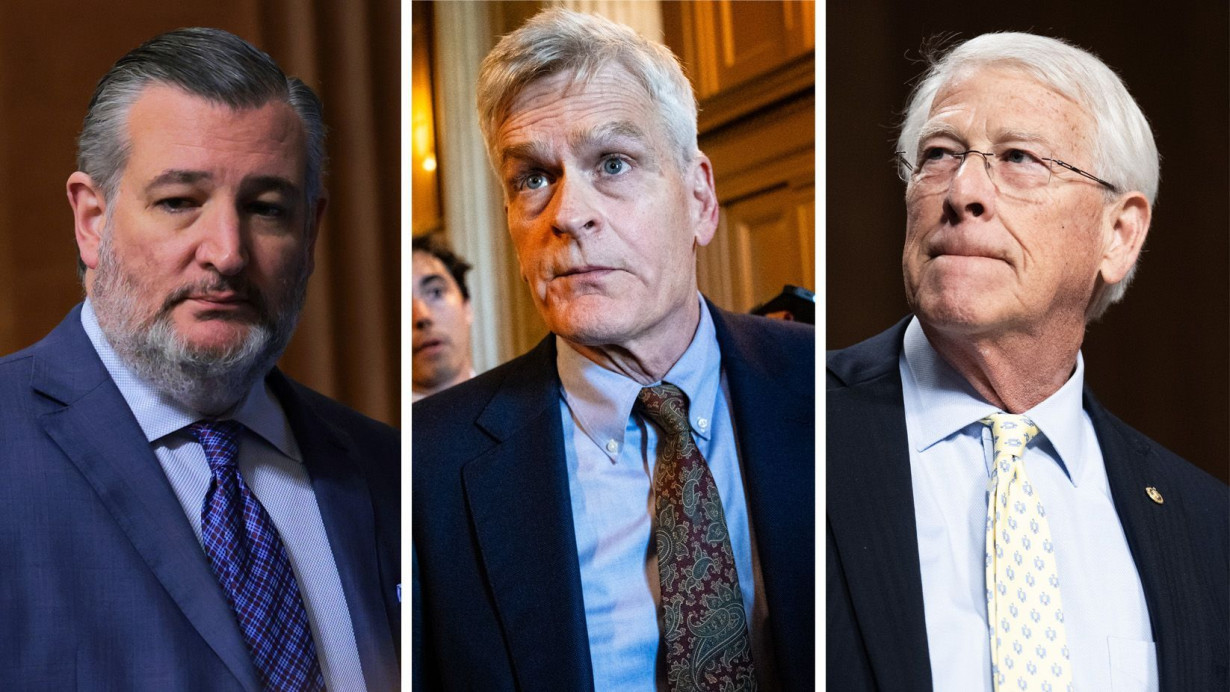
Some, mostly those unburdened by reelection campaigns, are full-on hammering Trump’s agreement, with outgoing Louisiana Sen. Bill Cassidy on Thursday summing it up as: “Iran’s left stronger, we are left weaker.” Texas Sen. John Cornyn, who’s also leaving Congress, said: “Everything I’ve heard about, it causes me concern.”
“It’s tough to say that the agreement is one that leaves Iran in a worse place and the United States in a better place,” Alaska Sen. Lisa Murkowski said, adding later: “A lot of money has been spent, some lives have been lost and yet you have Iran in a place where it almost looks like this is where they were before.”
But the more significant Republican voices are those who have rarely, if ever, veered from the Trump party line.
The growing chorus of Republican angst offers a flashing red warning sign to Trump: Without major changes, any final deal with Iran may not survive an eventual vote – even in a GOP-controlled Congress. Some doubt a final agreement will be reached at all, leaving Trump and the GOP in a messy limbo that could last for years and cost their party greatly in November.
There is “a high level of dismay” in the Senate GOP, according to one Republican senator, who was granted anonymity to speak candidly about party dynamics. The senator was also pessimistic about the prospects of a final agreement, saying they thought it unlikely that Iran would actually agree to a final deal.
Senate Majority Leader John Thune initially said little on the president’s agreement, telling reporters he was still “digesting” the details and later adding that he wanted “to make sure that the financial incentives are conditioned upon Iran’s performance,” particularly on its nuclear weapons. Later in the day, he called it “a step in the right direction” but noted that he saw it as a first step.
It all signals eroding support across the party, even among the president’s loyalists, at one of the most difficult stretches of Trump’s presidency, with growing GOP angst at his ballroom project, his retribution campaign, and, more recently, the battle over his intelligence chief. And it could complicate the White House’s push to accomplish much else before the midterms — including the looming battle over an expensive bill to pay for Iran war operations that GOP leaders hope to pass this summer.
One of those emerging voices of dissent is Sen. Roger Wicker of Mississippi, the top Republican on the Senate’s powerful Armed Services Committee. Wicker declined to comment for a full day after the White House revealed key details of the agreement. By Thursday, Wicker, who’s served three decades in Congress, issued a blistering statement blasting much of the agreement, particularly the $300 billion in rebuilding fund and the decision to lift sanctions.
“I am concerned that the memorandum of understanding negotiates away the victories of Operation Epic Fury in ways that are completely out of step with the President’s goals,” Wicker wrote in the statement. He said Trump’s plan for a $300 billion fund would make the perks for Iran in a prior deal with then-President Barack Obama “look like a pittance by comparison” — referring to the 2015 deal that he once said was so bad that it was reminiscent of the failed 1938 Munich Accords intended to stop Adolf Hitler.
Speaking to reporters about Trump’s emerging deal, Wicker was so careful with his public messaging that he declined to answer further questions, instead passing out copies of his statement to reporters. But Wicker was not alone in his sharp criticism of Trump’s negotiations.
Sen. Ted Cruz of Texas, a staunch Iran hawk, lit into Trump’s push for that $300 billion reconstruction fund, releasing frozen assets and allowing Iran to potentially profit from reopening the Strait of Hormuz.
“History demonstrates that giving billions of dollars to theocratic lunatics who want to murder us is an exceptionally bad idea, and I think unfortunately the president is receiving some really bad advice on this deal,” Cruz said. “If we give billions of dollars to Iran, that money will be used to murder Americans, and so I don’t believe we should do that.”
Another Iran hawk, Sen. Joni Ernst of Iowa, who is retiring at the end of her term, was uncharacteristically critical in her assessment.
“I think there are many of us that just really want to fully understand what the administration is thinking, where they’re going to go with this,” she told reporters. Asked about the $300 billion fund, she said, “I have to know where that money is coming from, because I don’t think my constituents are going to be really happy about it if that’s all US taxpayer dollars.”
As the White House struggled to sell the agreement, many senators said they awaited a detailed briefing from the administration. On Thursday afternoon, the White House held its first call with members to walk through the specifics, briefing congressional leadership and top lawmakers on the Senate Foreign Relations Committee and House Foreign Affairs Committee, a person familiar with the matter said.
Also Thursday, Vice President JD Vance downplayed the significance of the blowback coming from Capitol Hill.
“I guess I would say to anybody, any of the critics is: Number one, have a little bit of faith in the president United States. The idea that he is going to strike a deal that’s been bad for the American people, it’s preposterous,” Vance said during a White House press briefing, adding later: “I don’t think our public messaging has been chaotic.”
Some senior Republicans, like South Carolina Sen. Lindsey Graham, have personally been in touch with some of Trump’s negotiators.
But skeptical allies noted in particular the absence of Secretary of State Marco Rubio in publicly touting the agreement — an Iran hawk widely trusted by Republicans in Washington.
“To make JD Vance the face of it rather than Marco Rubio, it’s not going to increase confidence among Republicans that this is a good deal,” said a former senior Trump official, echoing lawmakers’ private worries that the administration was easing off Iran just as it should be maximizing its pressure. “The Iranians aren’t going to do jack sh*t, we’re going to give them a bunch of cash, they’re not giving up anything after that and you’re going to be accused of having done a bad deal.”
A tumultuous rollout from the start
Inside the White House, officials lamented that the US’ commitment to Iran and other mediating countries to not publish the text of the agreement until Friday was now hampering their ability to manage its rollout. Trump and several other senior officials, including Rubio, were also overseas at the G7 summit, limiting their ability to message the merits of the pact to lawmakers and allies back home.
Vance, who was already slated to talk with several media outlets about his new book, assumed the role of chief messenger, touting the agreement as a “win-win” that could transform the US’ relationship with Iran — or failing that, at least ensure that the nation’s nuclear capabilities had been decimated.
But he could only provide the broad strokes of the deal. And without a hard copy to share, Trump allies and GOP lawmakers largely declined to immediately endorse it — creating a vacuum that was quickly filled by vocal skeptics and a glut of conflicting information.
“We’re all pretending we know what’s in it,” one Trump adviser said this week, as frustrations spread across the Republican Party. “I don’t know what’s in it.”
Amid the intensifying scrutiny, Trump officials on Wednesday resorted to a creative way around the deal they’d made not to release the text: Reading it aloud to reporters on a conference call, enabling media outlets to effectively publish the agreement in full.
White House officials in the meantime sought throughout the week to tamp down GOP lawmakers’ anxieties, hoping to convince them to hold their fire in public.
Graham’s endorsement of the pact following a discussion with Middle East envoy Steve Witkoff — which came after the Iran hawk’s initial tepid reaction — was viewed by Trump officials as a particularly big victory. (Days earlier, Graham told reporters he was “skeptical” that Iran will drop its nuclear ambitions by the end of negotiations.)
But even Graham acknowledged Thursday that “some of the criticism of the [memo of understanding] is valid.”
Few Republican lawmakers have been willing to offer their full-throated support for the agreement — a reluctance that fed Trump’s anger over the days of unflattering coverage.
“These fools, who think I haven’t been tough enough on Iran, when the Stock Market Just Hit a RECORD HIGH, and Oil prices are ‘tumbling’ down, are either jealous, bad people, or stupid,” Trump posted on Truth Social at 4:32 a.m. ET on Thursday.
Some five hours later, he followed up: “OUR COUNTRY IS STRONG, SAFE, AND RESPECTED LIKE NEVER BEFORE. ‘YOU’RE WELCOME!’”
The-CNN-Wire
™ & © 2026 Cable News Network, Inc., a Warner Bros. Discovery Company. All rights reserved.