
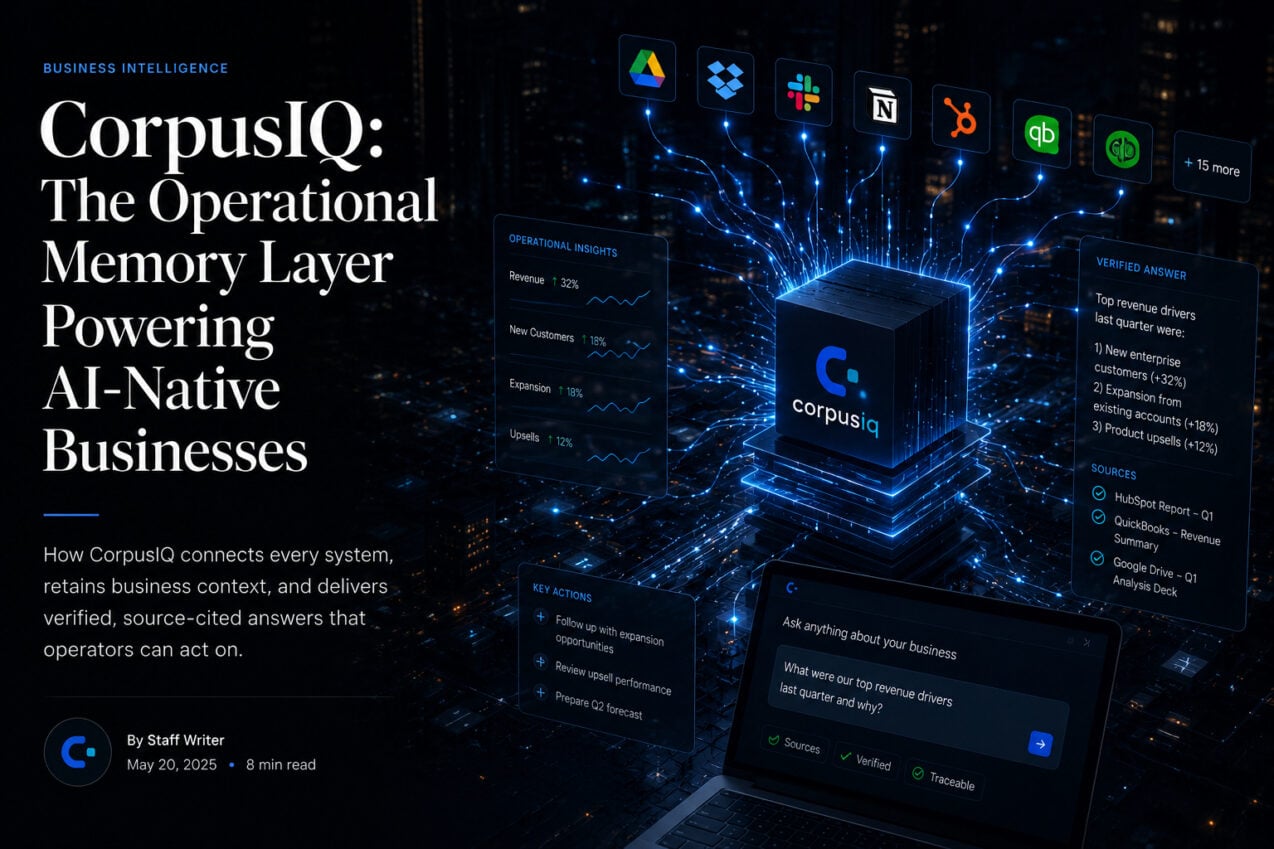
An LA digital advertising veteran of 28 years has moved to Scottsdale and is building what he calls the missing piece between business software and the AI assistants people now use every day.
SCOTTSDALE, AZ. When Benoit Pecqueur talks about his latest company, he sounds less like a founder pitching a product and more like an operator who got tired of watching the same problem repeat itself.
“Most small business owners are watching the AI revolution from the sidelines,” he says. “Not because they don’t want it. Because their tools don’t talk to ChatGPT or Claude. Their accountant still pulls reports from QuickBooks by hand. Their marketing person logs into five dashboards before they can answer one question. AI was supposed to fix that. Mostly, it hasn’t.”
His company CorpusIQ, headquartered in Scottsdale, was built to fix it. The platform connects two dozen business tools, including QuickBooks, Shopify, HubSpot, Gmail, and Google Drive, to AI assistants like ChatGPT, Claude, and Perplexity. The pitch is simple. Stop pasting CSVs into chat windows. Let the AI talk to your tools directly. Get answers with citations, not hallucinations.
It is a piece of plumbing, in other words. The kind of unglamorous infrastructure that gets ignored until it is missing.
The bridge between two languages
Pecqueur, 56, is French, raised and educated in Montpellier before moving to the United States. He spent 28 years in Los Angeles before relocating to Scottsdale. He has the unusual habit, for a founder, of speaking fluently in two languages that rarely overlap. He reads architecture specs and reviews code with his engineering team. He also presents to boards, negotiates contracts with defense contractors, and runs operations on $185 million budgets.
“There are people who understand technology and there are people who understand business,” he says. “There are not many who do both. I have spent my career trying to be the person in the middle.”
That instinct shows up in his track record. In the late 2000s he founded AdDynamix in Los Angeles, a digital advertising platform that scaled to $24 million in annual revenue and 78 employees. At its peak the company processed 1.5 billion display ads per month for clients including AT&T, Disney, General Motors, Ford, Sony Pictures, and Microsoft. AdDynamix was acquired by Ybrant Digital, the parent company of Lycos, in a deal valued at over $10 million.
He later founded WakeBallast, a manufacturing company that ran on a different playbook entirely. WakeBallast made specialty hardware sold direct to consumers through Amazon, but Pecqueur quickly pushed the company into government contracting. By the time it was acquired in 2023, WakeBallast had supplied BAE Systems, Boeing, NASA, and four branches of the U.S. military. He led the contract negotiations himself.
“Government contracts are not glamorous,” he says. “They are slow, they are paperwork-heavy, they are unforgiving on compliance. But they teach you something. They teach you that real businesses run on the small things. The reconciliation that no one wants to do. The audit log that nobody reads until something goes wrong. The bridge between the spreadsheet and the contract.”
That experience, he argues, is exactly what most AI tools are missing.
What CorpusIQ actually does
The technical name for what CorpusIQ provides is a Model Context Protocol server. MCP is an open protocol introduced by Anthropic, the company behind Claude, that lets AI assistants connect to external data sources in a standardized way. CorpusIQ is one of the early commercial implementations focused on small and mid-size businesses.
Underneath the technical name, the product is a four-stage flow that turns a vague operator question into a cited answer. Pecqueur calls it the bridge layer.
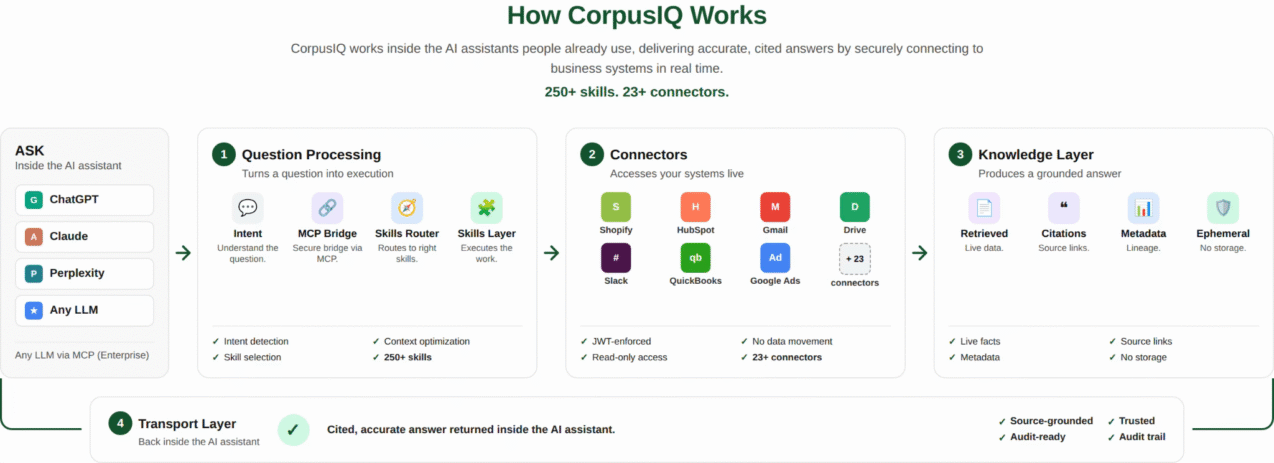
How CorpusIQ Works: a four-stage flow from question to cited answer.
The four stages, in order:
ASK. The user types a question into ChatGPT, Claude, or Perplexity. They do not write a prompt. They ask the question they would ask a person, like “how is my business doing this quarter.”
Question Processing. CorpusIQ receives the question through the MCP bridge. A skills router interprets intent and selects from a library of more than 250 pre-built skills. Skills are structured workflows, each one designed to answer a category of operator question. A skill called Cash Recovery Engine pulls overdue invoices, cross-references them with email threads, locates the relevant contracts, and produces a prioritized list of who to call first. Other skills cover ad spend attribution, marketing performance, contract compliance, vendor risk, and dozens more.
Connectors. Selected skills query the user’s actual business systems live. Twenty-three connectors and counting, including QuickBooks, Shopify, HubSpot, Gmail, Google Drive, Slack, Google Ads, and the rest of the stack a typical small business runs on. Access is read-only. Every query is JWT-permissioned. Data is never moved or stored.
Knowledge Layer. Retrieved data is assembled with citations and metadata into a single grounded answer. Source links are preserved. The context is ephemeral and built fresh on every query, so nothing persists in CorpusIQ servers between sessions.
Transport Layer. The cited answer is returned to the AI assistant the user originally asked. The user gets the answer inside ChatGPT, Claude, or Perplexity, with every claim backed by a source link. Audit trail logged.
“You did not write a prompt,” Pecqueur says. “You did not pick a skill. You did not specify which connector to query. You asked the question you would ask a human analyst. CorpusIQ asked the better questions on your behalf and answered them.”
Pricing reflects the focus on small and mid-size businesses rather than enterprise. Plans start at $29.95 per month for solo users, $109.95 for teams, and $189.95 for businesses. There is a 30-day free trial across every tier.
Compliance as a feature, not a footnote
For all the founder’s aversion to enterprise positioning, CorpusIQ has done the work that enterprises typically demand. The platform holds CASA Tier 2 certification from DEKRA, an OWASP-based security standard adopted by Google’s App Defense Alliance. It is SOC 2 aligned. All access is read-only by default. Customer data is never used to train AI models.
“In regulated industries this matters more than people realize,” Pecqueur says. “Real estate, financial services, healthcare, manufacturing with government contracts. They want AI. They cannot afford to leak customer data to it. We built CorpusIQ so the audit log is the first feature, not the last.”
The company recently announced enterprise availability through Microsoft Azure Marketplace and AWS Marketplace, distributed via a partnership with Tackle.io. The marketplace play is aimed at companies with existing cloud spend who want to procure CorpusIQ through their hyperscaler agreements rather than direct purchase.
A familiar bet, an unfamiliar layer
Pecqueur is direct about the audience. “We are not selling to enterprises. We are selling to founders, operators, and small teams who do not have a director of analytics. We replace the analyst layer underneath those jobs. Not the leader. The analyst.”
Asked what he learned from his earlier exits that he is applying now, Pecqueur thinks for a moment.
“At AdDynamix we scaled too fast and built features customers did not ask for. At WakeBallast we built only what customers paid for, and we exited at a smaller multiple but a better business. With CorpusIQ I am trying to do the second one again. Listen to the operator. Build the boring infrastructure. Ship the feature that audits itself.”
He grins. “Boring infrastructure is how you get to a bigger second exit.”
———
CorpusIQ is based in Scottsdale, Arizona. More information at corpusiq.io.